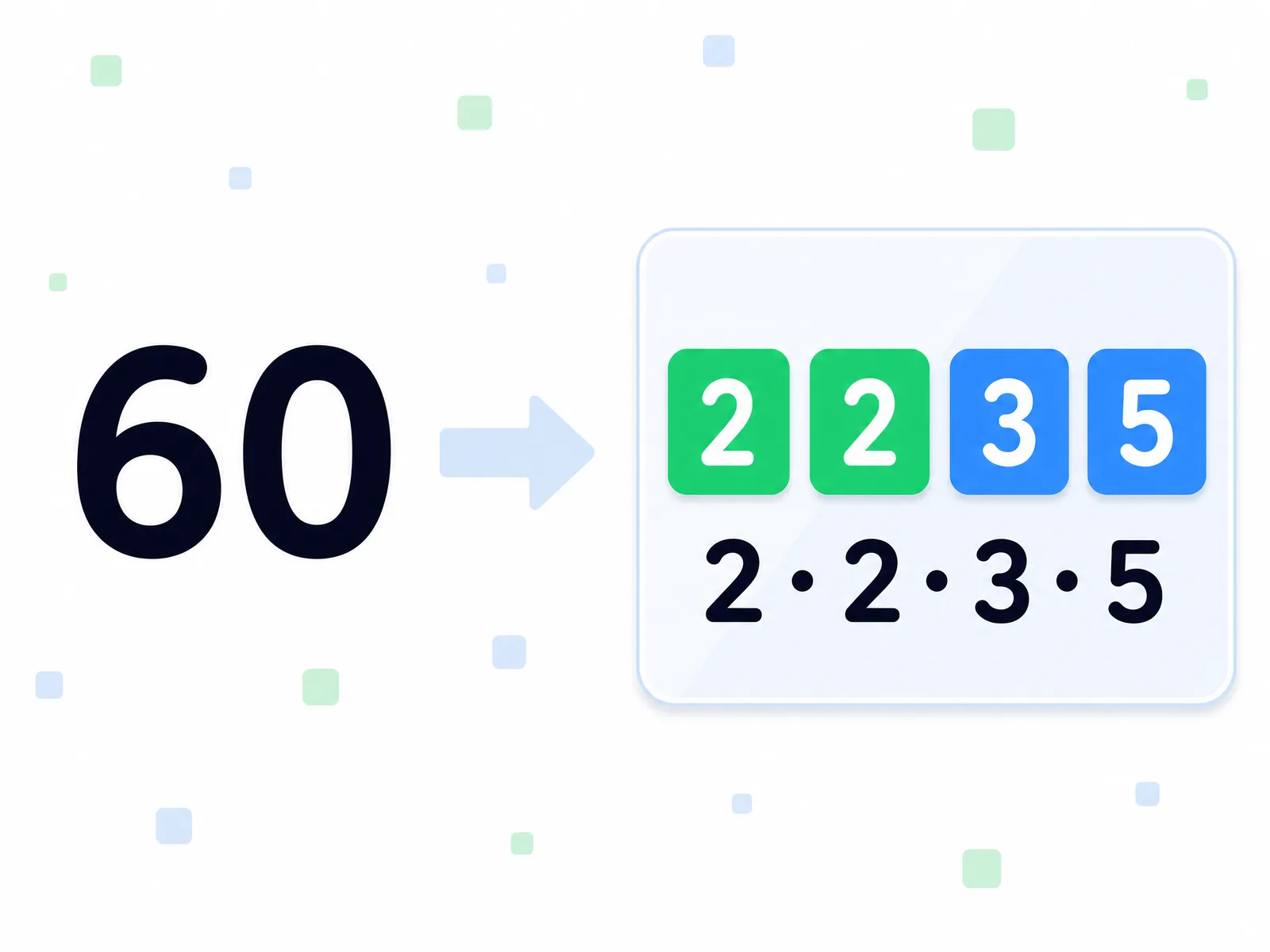
For Grade 6–8 students, parents, and educators.
Prime factorization can sound like a topic reserved for advanced mathematicians. In reality, it is a practical way to look inside a number and discover what it is made of. Once you learn to break numbers into their smallest useful parts, you can solve sharing problems, compare quantities, understand calendar rules, and build stronger mental-math instincts.
This guide explains prime factorization for students, parents, and educators in clear middle-school language. It also introduces Primorize, a browser game designed to help players practice breaking numbers into prime factors quickly and accurately.
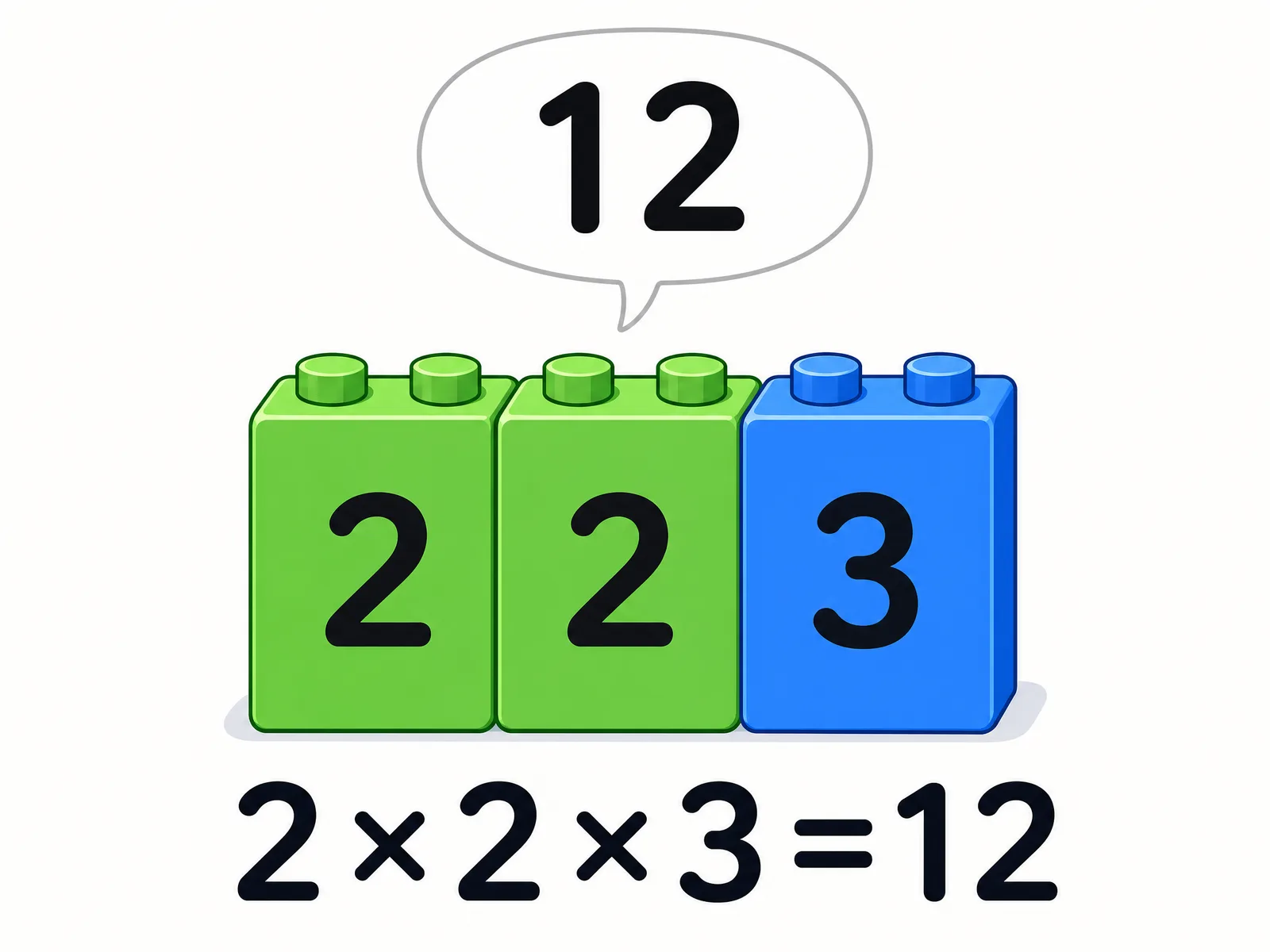
1. All Numbers Are Built from “Prime LEGO Bricks”!
What does “prime factorization” mean?
Let us unpack the phrase one word at a time.
A factor is a whole number that divides another whole number evenly, with no remainder. For example, 3 is a factor of 12 because 12 ÷ 3 = 4. The number 4 is also a factor of 12 because 12 ÷ 4 = 3.
A prime number is a whole number greater than 1 with exactly two positive factors: 1 and itself. The first few prime numbers are 2, 3, 5, 7, 11, 13, 17, and 19. The number 2 is the only even prime number.
A composite number is a whole number greater than 1 that has more than two positive factors. For example, 12 is composite because it can be divided evenly by 1, 2, 3, 4, 6, and 12.
Finally, prime factorization means writing a composite number as a product of prime numbers. The product is the result of multiplication.
So:
12 = 2 × 2 × 3
Because 2 and 3 are prime, this is the prime factorization of 12. We can also use exponents to write repeated factors more compactly:
12 = 2² × 3
The exponent 2 tells us that two copies of the prime factor 2 are being multiplied.
The LEGO analogy
Imagine opening a box of LEGO bricks. A large LEGO creation may look like one complete object, such as a castle, vehicle, or robot. However, it is really made from many individual bricks.
Numbers work in a similar way. A composite number is like a complete LEGO creation. Its prime factors are the individual bricks that cannot be broken into smaller prime-number pieces.
A number      →  a LEGO creation
A factor      →  a piece that can help build the creation
A prime       →  an indivisible LEGO brick in this analogy
Factorization →  taking the creation apart to identify its basic bricks
The analogy has one important limit: real LEGO bricks can sometimes be separated in many physical ways, while prime factorization has a unique result apart from the order of the factors. For example, you may begin factoring 60 in different ways, but you will always end with the same prime bricks:
60 = 2 × 2 × 3 × 5 = 2² × 3 × 5
Four examples, step by step
Example 1: 12
Start with a factor pair such as 2 and 6. The 2 is prime, but 6 is composite, so split 6 into 2 and 3.
12 = 2 × 6
   = 2 × 2 × 3
   = 2² × 3
The prime bricks are 2, 2, and 3.
Example 2: 18
Start with 2 and 9. Then split 9 into 3 and 3.
18 = 2 × 9
   = 2 × 3 × 3
   = 2 × 3²
The prime bricks are 2, 3, and 3.
Example 3: 60
One route is to split 60 into 2 and 30, then continue breaking down the composite numbers.
60 = 2 × 30
   = 2 × 2 × 15
   = 2 × 2 × 3 × 5
   = 2² × 3 × 5
The prime bricks are 2, 2, 3, and 5.
Example 4: 84
Begin with 2 and 42. Then split 42 into 2 and 21, and split 21 into 3 and 7.
84 = 2 × 42
   = 2 × 2 × 21
   = 2 × 2 × 3 × 7
   = 2² × 3 × 7
The prime bricks are 2, 2, 3, and 7.
| Number | Prime factorization | Prime bricks |
|---|---|---|
| 12 | 2² × 3 | 2, 2, 3 |
| 18 | 2 × 3² | 2, 3, 3 |
| 60 | 2² × 3 × 5 | 2, 2, 3, 5 |
| 84 | 2² × 3 × 7 | 2, 2, 3, 7 |
This way of thinking is useful because it turns a large-looking number into a short list of simple primes.
2. Three Real-World Applications of Prime Factorization
Prime factorization is not just a worksheet exercise. It supports important ideas in technology, calendars, and everyday decision-making.
1. Cybersecurity and RSA encryption
When you log in to a website, send a message, or visit a site using HTTPS, mathematical systems help protect information from unauthorized readers. One area of cybersecurity uses public-key cryptography, in which related keys have different jobs.
A public key can be shared. A private key must remain secret. The public key can help establish a secure connection or verify a digital signature, while the private key proves ownership or helps complete the secure operation.
RSA, named for Rivest, Shamir, and Adleman, is a public-key algorithm used for key establishment and for generating and verifying digital signatures.[1] Its traditional security idea is connected to prime factorization:
- Choose two very large prime numbers.
- Multiply them to create a large composite number.
- Publish certain information related to the product.
- Keep the original prime factors secret.
- Make it difficult for an attacker to recover the hidden primes by factoring the enormous product.
For small numbers, factoring is easy. You can factor 60 in seconds:
60 = 2² × 3 × 5
For appropriately chosen enormous numbers, finding the original prime factors is much harder with known classical methods. That difference between multiplying known numbers and factoring a huge product is central to the simplified RSA story.
A careful explanation matters. RSA is one cryptographic algorithm, not a claim that “90% of Internet traffic” is encrypted by RSA itself. In modern secure connections, public-key methods may help authenticate a server and establish session keys; symmetric encryption generally protects the bulk data after the connection is established. The practical lesson for students is more precise and more interesting: prime numbers can become part of the mathematical machinery that protects digital communication.
2. Calendars and schedules: the leap-year rule
A calendar year is not exactly the same length as Earth’s seasonal cycle. The tropical year is approximately 365.2422 days, so a calendar that always used 365 days would slowly drift away from the seasons.[2]
The Gregorian calendar corrects this drift with a divisibility rule:
A year divisible by 4 is usually a leap year.
A century year divisible by 100 is not a leap year.
However, a century year divisible by 400 is a leap year.
You can test the rule step by step.
- 2024 is divisible by 4 and is not a century year, so it is a leap year.
- 1900 is divisible by 4 and 100, but not by 400, so it was not a leap year.
- 2000 is divisible by 4, 100, and 400, so it was a leap year.
- 2100 will be divisible by 4 and 100, but not by 400, so it will not be a leap year.
The rule creates 97 leap days in each 400-year cycle. That produces an average Gregorian calendar year of 365.2425 days, which stays very close to the seasonal year.[2]
This is a real system built from divisibility checks. You do not need to factor every year completely to apply the rule, but the same mental habit is involved: examine a number’s divisibility properties and use them to make a reliable decision.
3. Fair sharing and everyday math
Suppose you have 24 treats and want to share them equally. Which group sizes work?
The answer comes from the factors of 24:
24 = 2 × 2 × 2 × 3 = 2³ × 3
Because 2, 3, 4, 6, 8, and 12 are factors of 24, you can share 24 treats equally among any of those numbers of people. You can also share among 1 person or 24 people.
24 treats ÷ 2 people  = 12 each
24 treats ÷ 3 people  = 8 each
24 treats ÷ 4 people  = 6 each
24 treats ÷ 6 people  = 4 each
24 treats ÷ 8 people  = 3 each
Sharing among 5 people does not work evenly because 5 is not a factor of 24. The division leaves a remainder.
Prime factorization explains where the possible group sizes come from. The prime bricks in 24 are three 2s and one 3. By combining those bricks in different ways, you can create its factors:
1, 2, 3, 4, 6, 8, 12, 24
This connection also appears in other tasks:
- Finding the greatest common factor helps you make the largest equal groups.
- Finding the least common multiple helps you coordinate repeating schedules.
- Divisibility rules help you check answers quickly without long division.
- Factor pairs help you arrange objects into equal rows and columns.
Prime factorization is therefore a compact description of the ways a number can be organized.
3. Visual Mental Rules: How to Picture Prime Factorization
Pictures are powerful because they let you see a process instead of memorizing isolated answers.
Visual 1: The Factor Tree for 60
The standard name for this diagram is a Factor Tree or Prime Factorization Tree. It starts with one number and branches into factor pairs. Each composite branch continues splitting until every endpoint is prime.
Read the prime endpoints from left to right:
60 = 2 × 2 × 3 × 5
   = 2² × 3 × 5
The order of the branches may change. For example, another student might begin with 10 × 6:
              60
            /    \
           10      6
          /  \    / \
         2    5  2   3
This tree gives the same result:
60 = 2 × 5 × 2 × 3
   = 2² × 3 × 5
The branching path can look different, but the final prime building blocks are the same. This is a visual way to understand the Fundamental Theorem of Arithmetic: every whole number greater than 1 has exactly one prime factorization, except for the order in which the primes are written.
Visual 2: The Prime Stack
A Prime Stack shows the prime factors as blocks placed one above another. It is especially useful for building mental images of exponents.
For 84:
       ┌───┐
       │ 7 │
       ├───┤
       │ 3 │
       ├───┤
       │ 2 │
       ├───┤
       │ 2 │
       └───┘

84 = 2 × 2 × 3 × 7 = 2² × 3 × 7
For 18:
       ┌───┐
       │ 3 │
       ├───┤
       │ 3 │
       ├───┤
       │ 2 │
       └───┘

18 = 2 × 3²
Design the Prime Stack like a tower of equal-sized blocks. Put one prime factor in each block. Use matching colors for repeated primes, such as one shared color for both 2-blocks in 84. Place the exponential form next to the tower so students can connect “two 2-blocks” with 2². A comparison display can show several stacks side by side:
The purpose is not artistic perfection. The purpose is to train your brain to recognize the structure of a number quickly.
4. Gamify Your Math Skills: Introducing Primorize
Primorize is a browser-based prime-factorization game. Its central action is simple: look at a number, choose prime blocks that divide it evenly, and continue until the remaining number is prime. The game’s public instructions describe three modes: Challenge Mode, Time Attack, and Practice Mode.[3]
Challenge Mode (Divisibility Practice)
In Primorize this mode is called Challenge Mode. Your goal is to keep solving problems while you still have lives. Each question asks you to identify prime factors that divide the displayed number.
This mode creates a useful balance between accuracy and pressure. You must check whether a prime really divides the number, but you also want to avoid spending too long on one question. If you make repeated mistakes, your lives run out.
The mode is similar to a survival challenge. Instead of practicing one isolated example and stopping, you build a chain of correct decisions. That repeated chain encourages automatic recall of familiar divisibility patterns:
- A number ending in 0, 2, 4, 6, or 8 is divisible by 2.
- A number whose digit sum is divisible by 3 is divisible by 3.
- A number ending in 0 or 5 is divisible by 5.
- A number is divisible by 7 only when division confirms it or when you have learned a reliable test.
Time Attack Mode
Time Attack Mode turns prime factorization into a speed drill. The goal is to solve as many questions as possible before time ends. Common challenge lengths include 90 seconds, 2 minutes, and 3 minutes, allowing players to choose a short burst or a longer session.
Speed should come after understanding. A good progression is:
- Factor slowly and accurately.
- Notice which primes appear frequently.
- Use divisibility checks before guessing.
- Reduce hesitation through repeated practice.
- Increase speed while protecting accuracy.
A fast wrong answer is not better than a careful correct answer. The strongest mental-math agility combines both.
Practice Mode
Practice Mode removes the pressure of a ticking clock and limited lives. It is the best place to begin if prime factorization still feels unfamiliar.
When a player makes a mistake, the game provides an explanation immediately, according to the public instructions.[3] That feedback is valuable because it connects the choice on screen with the mathematical reason behind the answer.
Try the following routine:
- Start with numbers you can factor using 2, 3, and 5.
- Say the factorization aloud or whisper it to yourself.
- When you make a mistake, identify the exact step where the number stopped dividing evenly.
- Rebuild the number by multiplying the prime factors back together.
- Move to a timed mode only after the process feels reliable.
The goal is not to memorize a random collection of answers. The goal is to develop intuition for the hidden structure of numbers.
A sample Primorize-style thinking routine
Suppose the displayed number is 84.
84 is even, so choose 2.
84 ÷ 2 = 42.
42 is even, so choose 2 again.
42 ÷ 2 = 21.
21 is divisible by 3.
21 ÷ 3 = 7.
7 is prime, so stop.

84 = 2 × 2 × 3 × 7 = 2² × 3 × 7
This is exactly the kind of repeated decision-making that builds mental fluency. With practice, you begin to see likely prime blocks before writing every intermediate line.
5. Frequently Asked Questions
What is the difference between a prime number and an odd number?
“Prime” and “odd” describe different properties.
An odd number is a number that is not divisible by 2. Examples include 1, 3, 5, 7, 9, and 11.
A prime number has exactly two positive factors: 1 and itself. Examples include 2, 3, 5, 7, and 11.
The number 2 is prime but even. The number 9 is odd but not prime because it has more than two factors:
9 = 1 × 9 = 3 × 3
So 9 is composite. Being odd does not automatically make a number prime.
Why is 1 not considered a prime number?
The standard definition says that a prime number has exactly two positive factors: 1 and itself. The number 1 has only one positive factor, which is 1. Therefore, 1 is neither prime nor composite.
There is also a deeper reason. Prime factorization is supposed to be unique. If 1 were prime, you could insert unlimited copies of 1 into every factorization:
12 = 2² × 3
12 = 1 × 2² × 3
12 = 1 × 1 × 2² × 3
That would make the basic building-block description messy and no longer unique in the useful way mathematicians need. Keeping 1 outside the prime numbers preserves the Fundamental Theorem of Arithmetic.
Do different Factor Trees give different answers?
They may look different while still producing the same prime factorization. For example, one Factor Tree for 60 may begin with 2 × 30, while another begins with 10 × 6. Both end with two 2s, one 3, and one 5.
The order of prime factors does not matter because multiplication is commutative:
2 × 3 × 5 = 5 × 2 × 3
Is every factor of a number prime?
No. A factor can be prime or composite. For 60, 3 and 5 are prime factors, but 6, 10, 12, 15, and 20 are also factors even though they are composite. Prime factorization continues breaking composite factors down until only primes remain.
Why should students practice prime factorization mentally?
Mental practice helps you recognize divisibility patterns without relying on a calculator for every step. That fluency supports fractions, greatest common factors, least common multiples, exponents, ratios, probability, and algebra. A game such as Primorize adds repeated decision-making and immediate feedback, which can make practice more engaging.
6. Conclusion: Get Your “Number X-Ray Vision”!
Prime factorization gives you a way to see through the surface of a number. Instead of treating 60 as one large object, you can recognize it as 2² × 3 × 5. Instead of guessing whether 24 can be shared equally, you can use 2³ × 3 to identify its possible group sizes. Instead of seeing leap years as a mysterious calendar rule, you can recognize a carefully designed set of divisibility checks.
The LEGO analogy makes the central idea memorable: every LEGO creation is built from individual bricks, and every composite number can be rebuilt from prime-number bricks. Factor Trees show the process. Prime Stacks show the result. Practice turns the written steps into mental patterns.
Primorize makes that practice active. Begin in Practice Mode, use the explanations to correct your thinking, and then move into Challenge Mode or Time Attack Mode when you are ready to push yourself.[3] Over time, you will not simply calculate prime factorizations. You will develop “number X-ray vision”—the ability to glance at a number and start seeing its hidden construction.